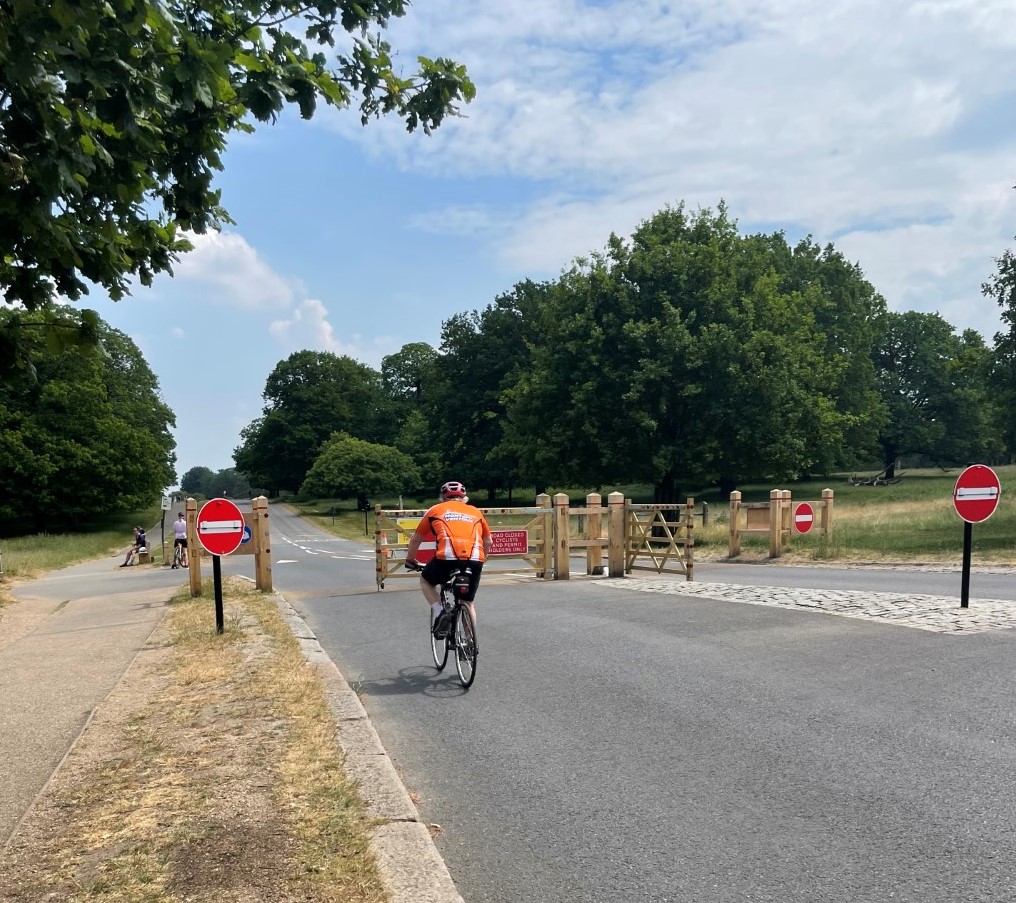
Former RAF Little Staughton

Former RAF Little Staughton

Each week at TMS, we can be commissioned by our clients to audit a huge array of different types of highway and development schemes, in a diverse range of places throughout the country. Anything from multilevel grade separated junctions, involving flyovers, underpasses, interchange links, slip-roads and loop roads to simple priority junctions, crossings, and mini-roundabouts.  This week was no different.

One of our audit teams, Richard Marriott and Lee Williams, carried out a Stage 2 Road Safety Audit on the section 278 works for a new access on a small residential development, consisting of seven dwellings.  The scheme forms part of the governments affordable housing project.  The site and village were formerly part of RAF Little Staughton, a quaint village in Cambridgeshire.

During World War II the airfield was home to the Avro Lancaster bombers as part of No. 582 Squadron, and these were replaced by the de Havilland Mosquito of No. 109 Squadron.  After the war, the airfield was handed over to the United States Air Force who extended the runway to accommodate jet engine aircraft that required an emergency landing.  The airfield was abandoned in the late 1950’s, with only the runway remaining.

The audit team commented: “During the site visit, on the village green, it was lovely to see the small, but fitting, memorial to the station and all that served during World War II.  We feel very fortunate to be able to audit such vastly different highway schemes in such diverse locations and be able to see some unusual sights along the way.”

At TMS, we have extensive experience in carrying out Road Safety Audits, at all stages, for small and large scale residential developments including Section 278, Section 38 and Section 111 schemes.

If you have a scheme that requires a Road Safety Audit on a new housing development, or any other highway scheme, then please call us on +44 (0)24 7669 0900 or alternatively please email Lorna Styring.

Sustainable Drainage Schemes (SuDS)

Sustainable Drainage Schemes (SuDS)

TMS have recently been involved in auditing various Sustainable Drainage improvement schemes (SuDS).  Alongside being commissioned to audit this type of scheme by our clients, our auditors also come across many interesting and diverse Sustainable Drainage improvement schemes on their travels, especially within new residential developments.

swale drainage near playground, new houses, SuDS

Sustainable Drainage Systems (SuDS) are designed to manage stormwater locally (as close to its source as possible) to mimic natural drainage and encourage its infiltration, attenuation and passive treatment.  SuDS are used to reduce the impact of rainfall on new developments, by using soakaways, grassed areas, permeable surfaces and wetlands.


Neal and Hammy came across an interesting Sustainable Drainage Scheme (SuDS) in Tiddington, Warwickshire whilst carrying a Stage 3 Road Safety Audit. With swales bordering a child play area, the surrounding carriageway was made with permeable blockwork to allow drainage into the swales.

The swales, which are designed to trap the surface water run off allowing it to soak into the ground, are not too deep and therefore are safe for the children playing in the vicinity.  The audit team commented “it was quite a pleasant looking scheme with a novel approach to the drainage within the estate”.

swale drainage near playground, new houses, SuDS

Neal and Lee also carried out a Stage 1 Road Safety Audit on a Sustainable Drainage scheme in Whitstable, Kent.  The scheme consisted of amendments to the carriageway drainage, with direct connection into new conveyance swales within the park, recreation ground and landscaping works.  The outlook and purpose of the scheme was very similar (as can be seen from the artist’s impression of the final product).

If you have a scheme of this nature that requires a Road Safety Audit, then please call us on +44 (0)24 7669 0900 or alternatively please email Lorna Styring.

EV Charging around the UK

EV Charging around the UK

TMS have been touring the UK to undertake various Road Safety Audits on infrastructure associated with sustainable power installation, such as solar farms, electric vehicle charging points and battery storage facilities.
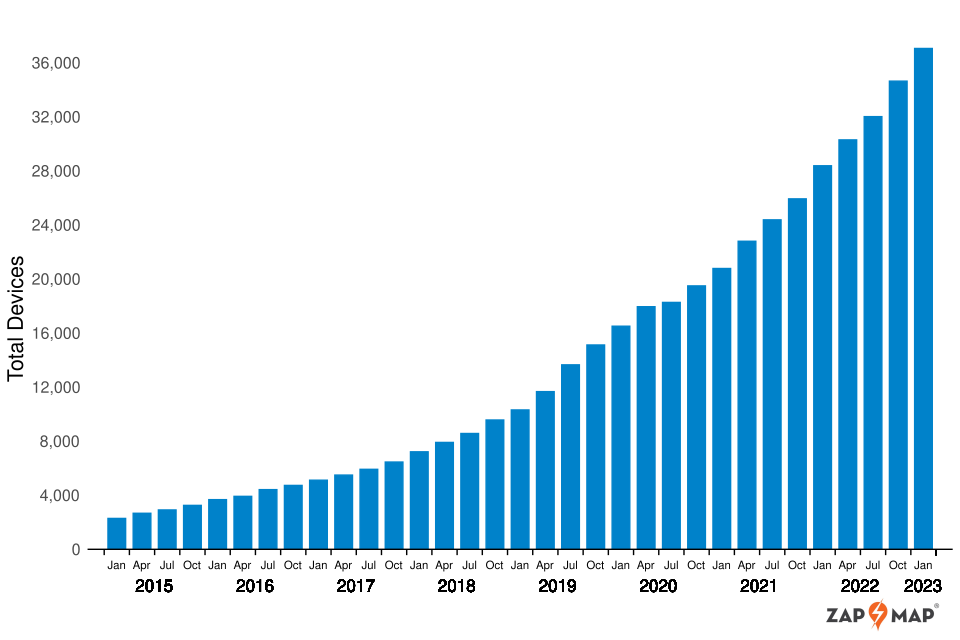
Map of the number of UK public charging devices

There has been rapid growth in electric vehicle charging (EV) points in the UK since the first electric vehicle charging points were installed in the early 2000’s. However, since the mid 2010’s EV charging points have become a common sight on the public highway and car parks throughout the UK.  In January 2015 there were 2,283 charging devices, with 195 of these being rapid charging or above. Compare that to June 2023, where there are now over 44,000 charging devices with over 8,000 of these being rapid or above.


The rise of fully electric cars has also followed a similar trend. According to ZapMap, in 2016 there were 30,669 fully electric vehicles there are now 816,668 in 2023.  At the end of 2016 just 0.4% of all new vehicles registered were electric, this had risen to 16.6% by the end of 2022.
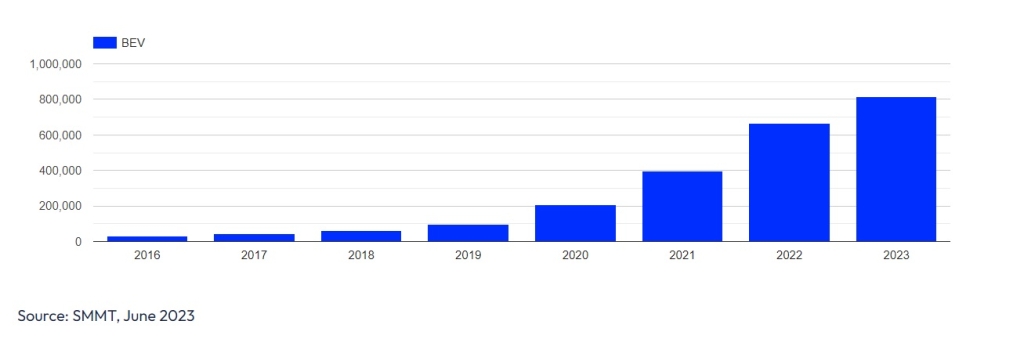
cumulative number of battery electric vehicles registered in the UK 2016 - 2023
Cumulative number of battery-electric vehicles in the UK (2016 to July 2023)

To cope with the increasing demand for electric vehicles, many of our clients are proposing to install rapid EV chargers (100KW) on the public highway in city centre locations.  If electric vehicles are going to be an option for city centre residents, there is a requirement for an effective and convenient network of public charge points for everyone to use.

The Birmingham city-wide EV charge point strategy is an example of what local authorities can do to ensure that residents (particularly those who do not have access to off-street parking), taxi drivers, commercial fleets and visitors to the city, have access to a convenient charge point when they choose to go electric.

EV Charging point on the road

Over the past year, we have carried out numerous design stage Road Safety Audits on EV charging points, at various locations within Birmingham City Centre and Barnet, for this very reason. Most of which utilising the existing marked parking bays with the addition of the kerbside charging unit. When carrying out a Road Safety Audit on electric vehicle charging points it is important to ensure that the location of the required infrastructure does not affect the safety of road users and pedestrians.

Solar Farm

We have also audited a priority junction access on a dual carriageway in Essex for a proposed battery storage unit and an access for a solar farm installation in Oxfordshire. The accesses are required for the purpose of construction of the site and ongoing maintenance vehicles thereafter.

Road Safety Audits on such schemes are becoming more and more frequent as the country intensifies it’s move towards such power sources.  TMS has carried out design stage road safety audits on both EV charging points and solar farms throughout the country, in places such as Greater London, Birmingham, Northamptonshire, Leicestershire, Oxfordshire, Surrey and Hampshire.

At TMS, we carry out a huge amount of Road Safety Audits each year throughout the UK.  If you have a scheme of this nature that requires a Road Safety Audit, then please call us on +44 (0)24 7669 0900 or please email Lorna Styring.


Digital Screen Advertisements – A distraction to road users?

Digital Screen Advertisements – A distraction to road users?

TMS has recently seen an increase in enquiries to carry out Road Safety Audits on proposed roadside Digital Screen Advertisements. We have recently carried out work in London for the Piccadilly Underpass and Hagley Road in Birmingham.  It is important that these types of schemes are audited to ensure road safety risks are assessed and they do not pose a prolonged distraction to road users.

Digital Screen Advertisements are now commonplace on the highway network, however, they can also be a factor in causing distraction to drivers.

In 2018/19, research into roadside advertising was carried out by the CEDR, a consortium of three research institutes; SWOV, TRL and Vias institute). Known as ‘ADVERTS‘ or, Assessing Distraction of Vehicle drivers in Europe from Roadside Technology-based Signage”, the project outcome was the creation of a set of ten recommendations for minimising distraction from roadside advertising.

  1. Don’t cause confusion with road signs
  2. Don’t block the road users view
  3. Avoid complex locations
  4. Don’t use moving images
  5. Don’t encourage non-driving actions
  6. Keep it simple
  7. Minimise transitions
  8. Don’t dazzle road users
  9. Don’t have flashing lights
  10. Avoid overlarge billboards

These recommendations are available from the ADVERTS website as a full report, a visualised summary of the ten recommendations listed above and a recorded webinar of the project and its main results.

The proposed screens in the schemes we audited were varied in size and the types of messages they displayed, with the newer advertisements proposed to feature subtle moving imagery. Therefore, the auditors assessed each location against several criteria including; proximity of existing infrastructure, conflict points and critical road user decision points.

The recommendations helped the clients to determine the suitability of the locations and decide whether mitigation measures would be necessary to minimise the risk of collisions.

Birmingham, West Midlands, England, UK. 17 May 2018. The A4400 Queensway duel highway , passing the City centre

TMS has experience in carrying out Road Safety Audits and independent safety/risk assessments for digital screen advertising projects.  The fundamental reason for clients commissioning studies of this nature is to ensure the proposed digital advertising does not cause significant distraction to drivers and to identify any potential road safety risks associated with the erection of the new digital screens.

If you have a scheme of this nature that requires a Road Safety Audit, then please call us on +44 (0)24 7669 0900 or alternatively please email Lorna Styring.

Back to top