Binley Cycleway

Binley Cycleway, Coventry

Coventry City Council have created a new segregated cycleway along Binley Road, between the Gulson Road and Clifford Bridge Road/ Brinklow Road junctions. A further section exists on Clifford Bridge Road between the Dorchester Way junction and the University Hospital in Walsgrave. Between these sections, there is a “missing link” which will be provided in the future.

TMS Consultancy, whose offices are based in Binley Business Park, are close to the cycleway and therefore provided an ideal opportunity for TMS Engineers to try out the new cycleway. Some highlights of the route are described below:

  1. Two-way cycleway is separated from traffic using kerbed segregation. The surface is high quality asphalt, which is coloured at some junctions and accesses to highlight it to road users.
A person riding a bike on a cycle way.
Copenhagen style crossings

2. Access to private properties have been created using “Copenhagen” style crossings, allowing the route to be continuous without interruption.

3. Cyclists have their own specific traffic signals at controlled junctions and crossings. In most cases, detection equipment gives priority to cyclists so that they turn green as cyclists approach.

Traffic signals at controlled junctions of the cycle way
Parallel Crossing that gives priority to cyclist

4. At side road junctions, Parallel Crossings (similar to zebra crossings) have been provided, giving priority to cyclists and so improving journey times by reducing the need to stop.

5. A cycle maintenance stand and parking is available at one location to allow cyclists to pump up their tyres, tighten bolts, etc, using the multiple tools available at the stand.

Floating stops and raised islands

6. The cycle route is made continuous at bus-stops by creating “Floating” stops on raised islands. The layout features crossing points across the cycle route allowing access for pedestrians.

Overall, our thoughts were that the cycleway provided a pleasant, comfortable, safe and efficient route for cyclists, particularly as it is separated from the busy road.

In our opinion, the cycleway met the core design principles for safe and efficient use by cyclists, which are set out in the Department for Transport Document “LTN 1/20 Cycle Infrastructure Design.” The core principles are that cycle infrastructure should be Coherent, Direct, Safe, Comfortable and Attractive. Once fully completed, the Binley Cycleway will provide an ideal way to cycle between the city centre and the hospital.

If you have a scheme of this nature that requires a Road Safety Audit, then please call us on +44 (0)24 7669 0900 or alternatively please email Lorna Styring.

Bristol Airport Transformation Proposals

Bristol Airport Transformations Proposals

Over the past couple of years, TMS has carried out numerous design stage Road Safety Audits on Bristol Airport’s proposed transformational public transport hub and new multi-storey car-park. The £60m project will enable the airport to increase its capacity to 12 million passengers a year (an increased capacity of two million).

Bristol Airport Improvements 3D model representation


The scheme involves creating an enlarged coach and bus interchange, together with a dedicated drop-off and pick-up location, on the top level of the new 2,000 space car-park. Pedestrian access will also be improved by providing a glazed bridge link to the airport from the car-park.

TMS has carried out Road Safety Audits on the new perimeter road, internal car-park layouts, car-park ramps and pedestrian routes. It is important that these areas can be negotiated safely by all users, especially as many people travelling to airports can be unfamiliar with the area and need clear information and guidance.

Image source: BBC News – Bristol Airport Invest £60m in transport hub and car park

Due to the increase in demand for more international travel over the last decade including the need for more flights and longer operating hours, the redevelopment of existing airport terminals forms a fundamental part of their long-term strategy for development.  Over the past ten years, TMS have also been involved in carrying out a variety of Road Safety Audits and Assessments on improvements at some of the other UK major airports including:

London Luton

Phased construction of a new link road associated with the brand-new Terminal 2 proposals, known as the Luton Rising Project. The project also involves several major junction upgrades within the towns of Luton and Hitchin. Proposed new public drop off zone at the original terminal, incorporating a reconfigured road layout to bus / coach station, taxi ranks and service areas.

Luton Airport Aerial View
Manchester Airport (Top) London Heathrow Terminal 2 (Bottom)

Manchester Airport

Highway works associated with the transformation of Terminal 2, including access road reconfiguration and development of new car-park accesses.

London Heathrow Terminal 2

Major reconstruction of terminal with multi-storey car-park, transport interchange and reconfiguration of central roads within the airport.


If you have a scheme of this nature that requires a Road Safety Audit, then please call us on +44 (0)24 7669 0900 or alternatively please email Lorna Styring.

TMS Host Engineers from Hong Kong

TMS Host Engineers from Hong Kong

Over the past 18 months, TMS played host to Joseph Wong and Wallace Soh from Ho Wang SPB Limited, who are based in Hong Kong, to enable them to gain experience in road safety auditing.

The aim was to be able to apply their skills learned in the UK for similar work in Hong Kong.  On their first visit to the UK in August 2022, Joseph and Wallace completed our 10-day RoSPA Road Safety Engineering course whilst attending various Road Safety Audit site visits as Observers.

Three people in yellow vests talking to a man on the side of the road.
Three people standing on a pavement near a road.

On their return to the UK in summer 2023, Joseph and Wallace observed the road safety audit process in more detail and attended numerous site visits in West London and in the counties of Gloucestershire, Northamptonshire, Leicestershire and Yorkshire.

The schemes ranged from junction improvements including roundabouts, traffic signals and priority junctions, new link roads and streets within commercial and residential developments. By visiting a diverse range of highway schemes, Joseph and Wallace were able to experience different types of schemes at varying stages of the audit process.

For one highway scheme at Prologis Park, Uxbridge, our audit team had the pleasure of having Joseph and Wallace join them for the Post Construction Stage 3 Road Safety Audit, a scheme they were also involved in at detailed design stage during their first visit.  Not only was it good for them to revisit a site they had previously been involved with, but to meet back up with the initial audit team and be included as Team Members.

Joseph Wong and Wallace Soh from Ho Wang SPB Limited on-site observing street furniture damage as a result of vehicle strikes due to incorrect sign face mounting – see photo (right)

three men looking at a sign in a street

TMS Technical Director, Hammy Aulak, commented:

“It was a pleasure to host Joesph and Wallace, who were both very keen to learn and engage fully in the Road Safety Audit process. I am confident that the knowledge and experience they have gained will help them to identify road safety hazards and suggest improvements to schemes in Hong Kong. We look forward to working collaboratively with them in the near future.”

Joseph Wong also commented:

“We are most grateful for allowing us to join as external team members for the five audits that give us a variety of experience.  We enjoyed every one of them particularly the two that we had participated in as night time RSA auditor”.

Parallel Crossings, Solihull

Parallel Crossings, Solihull

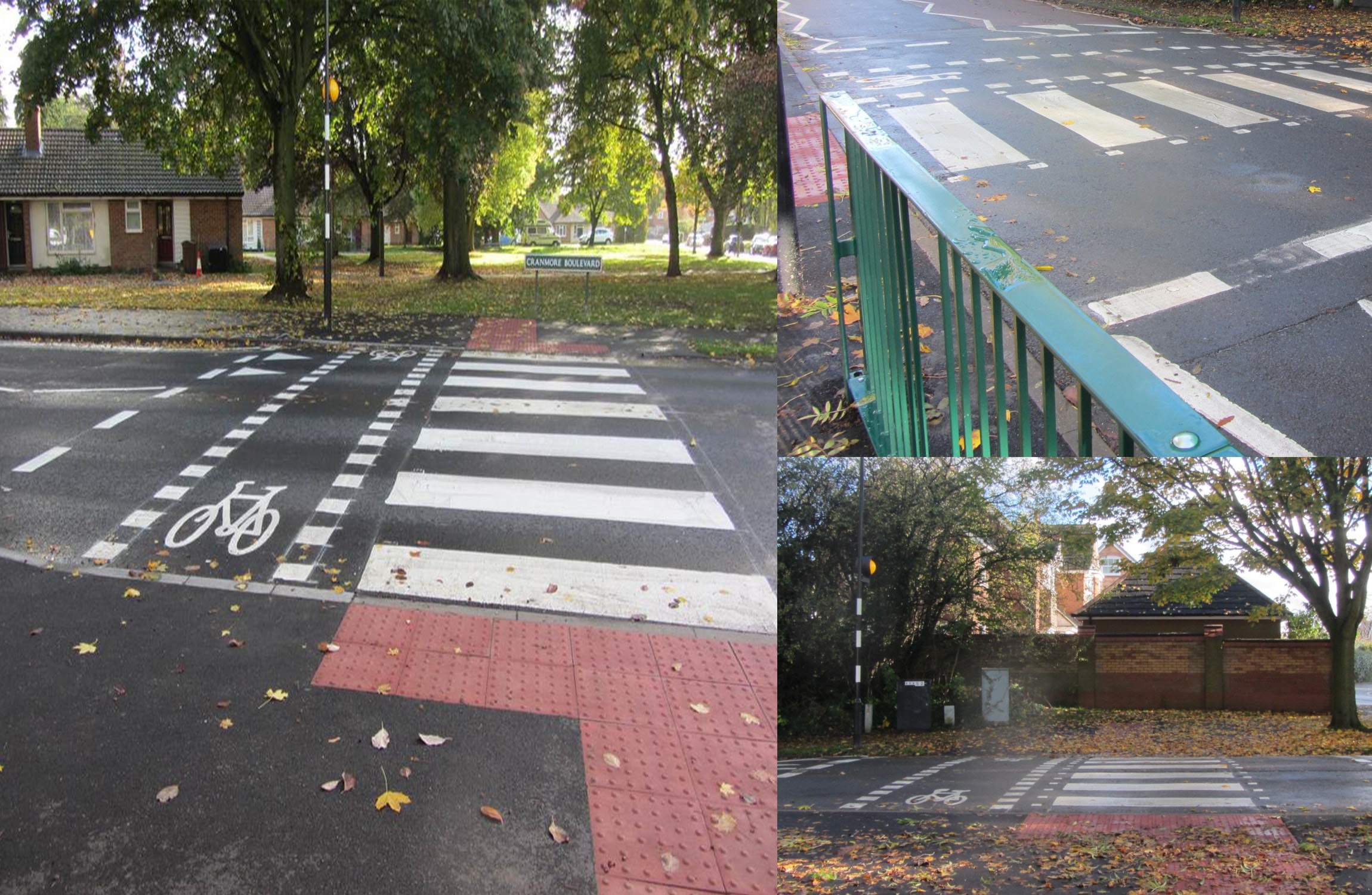
TMS has recently carried out several Road Safety Audits on Parallel Crossings on behalf of Solihull Metropolitan Borough Council. These types of crossings are still relatively rare in the UK, and were previously known as Tiger Crossings, as early examples had yellow stripes on black asphalt.

Parallel crossings are similar to Zebra Crossings, except that they feature a dedicated lane for cyclists parallel to the pedestrian crossing area, providing a legal priority to both cyclists and pedestrians. The advantage over Toucan Crossings is that crossing times can be quicker as people do not have to wait for a green man but can cross as soon as drivers stop for pedestrians and cyclists.

There is also less risk of conflict between pedestrians and cyclists as their lanes are separated. Therefore, they are ideal along segregated cycle routes as recommended in LTN 1/20 Cycle Infrastructure Design.

Although not shown in these examples in Solihull, parallel crossings can also be divided into two parts by way of a central refuge. In certain situations this is likely to improve the ease of use and safety, as both pedestrians and cyclists need only watch for oncoming traffic in one direction.
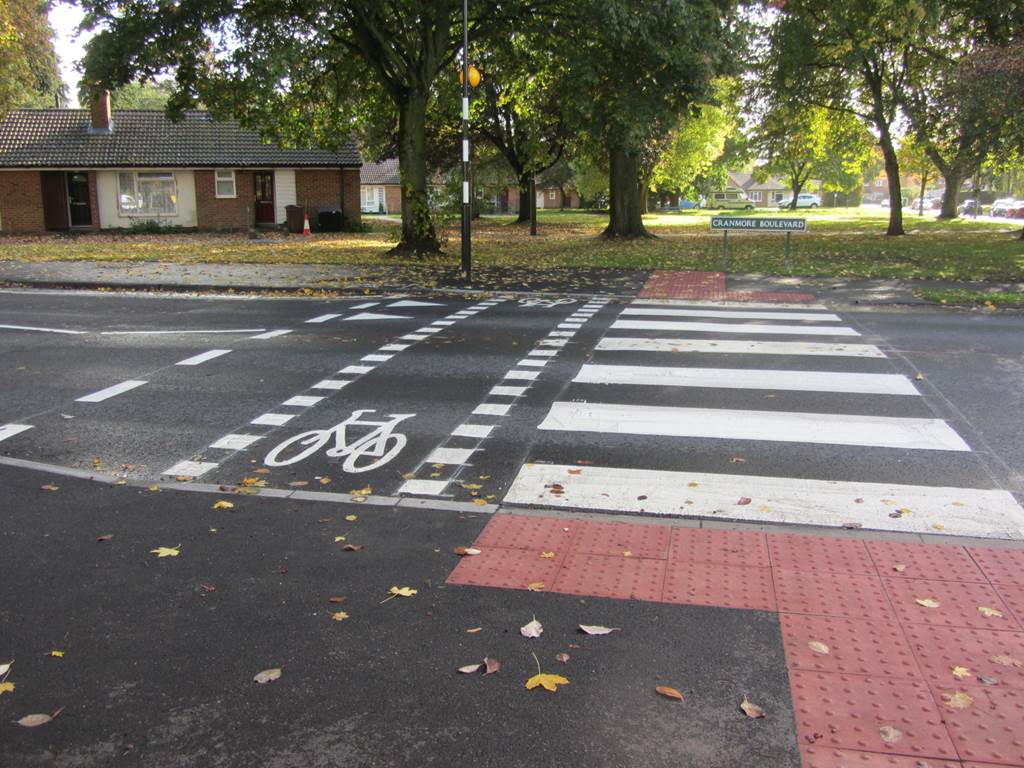
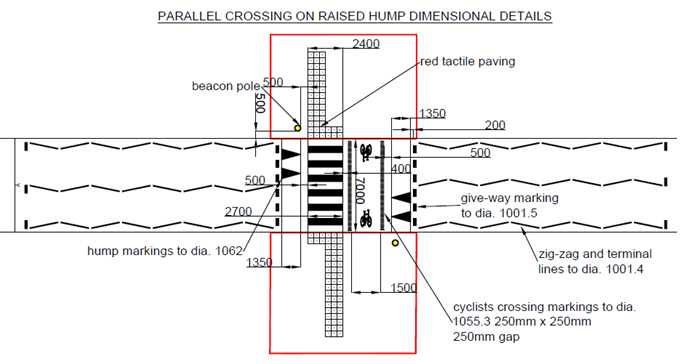
Parallel crossing on a main road in solihull
Three different Parallel Crossings that TMS has audited.


Our teams have audited several schemes in the Solihull area that have featured parallel crossings, at varying stages.  Examples include:

Cranmore Boulevard – Off-carriageway cycle route
Stage 3 Road Safety Audit

Whitefields Road – School Safety Improvement Scheme
Stage 3 Road Safety Audit

Monkspath Hall Road – Proposed raised Parallel Crossing
Stage 1&2 Road Safety Audit

If you have a scheme that requires a Road Safety Audit on a proposed parallel crossing, or any other highway scheme, then please call us on +44 (0)24 7669 0900 or alternatively please email Lorna Styring.
Back to top