Tribute to Malcolm Bulpitt

Tribute to Malcolm Bulpitt – A true pioneer in road safety engineering

It is with great sadness that we have learned of the death of our former Associate Malcolm Bulpitt who joined TMS after a career working in Road Safety for the GLC and Kent County Council.

Malcolm was one of the truly great pioneers in road safety engineering not just in the UK but internationally too. He was one of the first local authority engineers to introduce a road safety audit process at Kent, where he headed up the Accident investigation Unit and was responsible for implementing scores of life-saving road safety schemes throughout the county.

Malcolm came to TMS in 1997 and worked with us for 12 years until his retirement in 2009. At TMS his enthusiasm for road safety was a shining example to younger members of staff who learned so much from his good-humoured approach and his enthusiasm for his work.

He continued to undertake safety studies and road safety audits at TMS, but his main contribution was as a trainer, travelling the length and breadth of the UK and Ireland selling safety audit in his own inimitable style. His TMS work took him beyond the UK and Ireland to Canada, Australia and Iceland where he delivered talks at conferences and ran training courses with the same level of enthusiasm and attention to detail that he brought to his work at home.

Outside of his work, Malcolm was the editor of the Swiss Railway Society’s magazine Swiss Express.  This is a quarterly English-language magazine, which deals with railway and public transport operations in Switzerland. Malcolm edited the magazine for twelve years from 2006 before retiring. Malcolm joined the Society in 1982 and was awarded life membership for his services to the Society in 2022. This was something he was immensely proud of being involved in and always had some great stories to tell.

(Picture: Front cover of Swiss Express (June 2024), ©SwissRailwaysSociety)

Swiss Express June 2024 front cover

Following his retirement from TMS, Malcolm became a volunteer at the National Trust, working as an archivist and helping with car park management.

Malcolm will be very fondly remembered and greatly missed.  He was a huge part of our TMS family, and it was a privilege for all those who worked with him.

TMS Commended by RoSPA

TMS Commended for the Assured by RoSPA 10-Day Road Safety Engineering course

The Assured by RoSPA 10-Day Road Safety Engineering Course has been a flagship course at TMS for over 25 years. This course has evolved significantly, incorporating the latest industry practices and feedback to continuously improve its content and delivery. Most recently, it has become an Assured by RoSPA Qualification, a recognition that ensures the course meets the highest standards.

/

First Class Instructor-Led Provider of the Year (Commended)

A couple of months ago, we had the honour of being nominated for a RoSPA Qualification award in the “First Class Instructor-Led Provider” category. This nomination itself was a significant achievement, reflecting our commitment to excellence and the dedication of our team. We were thrilled to be invited to attend the award ceremony on the historic HMS Belfast.

The judging panel included four health and safety experts: Independent Public Health Consultant Dr Michael Craig Watson; RoSPA Qualifications board member Peter Brown; Chair of the RoSQual Governing Body, Brian Johnson; and RoSPA’s Achievements Director, Julia Small.

Jess Waldron (TMS), Steve Proctor (TMS), Tara Jowett (TMS) and Richard Cook (TMS) behind tower bridge and holding an award.
Richard Cook (TMS) and Tara Jowett (TMS) accepting the certificate.

Although we did not secure the top spot, it was an honour to be commended in our category. This recognition is a testament to the team’s work in ensuring that our training courses are up to the highest standards and that we continue to deliver first-class training to all of our delegates.

Our Director, Richard Cook, said, “We are very proud to have been commended in our category of First Class Instructor-Led Provider and to receive a commendation award. This is a testament to our team’s dedication and hard work, which ensures that the course is of the highest standards. The Assured by RoSPA 10-Day Road Safety Engineering course is essential for people starting their careers in road safety, and we are delighted to contribute to their early professional development. It is one of the ways that we can continue to achieve our goal of making roads safer for everyone.”

Julia Small, RoSPA’s Achievements Director, said: “As leaders in health and safety, we know how crucial it is for businesses to offer a high standard of training, whether in-house or through third-party providers. Quality training benefits everyone and securing a Course Assurance Award marks a company as an industry pioneer. We are thrilled that TMS Consultancy has been commended at the RoSPA Qualification Course Assurance Awards. Congratulations on your dedication to safeguarding people from accidental harm and injury.”

To find out more about the course please visit our Assured by RoSPA 10-Day Road Safety Engineering course page.

Junction Assessment Tool and Cycle Level of Service

Junction Assessment Tool and Cycle Level of Service

TMS have recently carried out a Stage 2 RSA on a Transforming Cities Fund (TCF) Public Realm Improvement Scheme, which involved carriageway realignment, footway widening, measures to restrict through traffic movements, and the reallocation/additional provision of Bus Shelters.

As part of the funding process the scheme had been designed to align with LTN1/20 guidance, namely improved bus journey times and provision for active travel. A balance for the use of the existing highway corridor was required to provide sensible and safe carriageway widths whilst maintaining suitable widths for cycleways and footways.

LTN1/20 guidance contains tools to give local authorities flexibility on the infrastructure design and sets out a measurable quality threshold to achieve when designing cycling and active travel schemes, namely the Junction Assessment Tool and Cycle Level of Service mechanism.

The Junction Assessment Tool (JAT) and Cycle Level of Service (CLoS) are new mechanisms introduced in LTN1/20 to set minimum quality criteria. These tools give local authorities flexibility on design of infrastructure but set an objective and measurable quality threshold.

Cycleway with cyclist on the cycle lane and pedestrian crossing the road.

Both mechanisms are comprehensive. A JAT examines all potential cycle movements at a junction, not just those that may be associated with a designated cycle route, to identify the potential for conflicts and should be used whenever new and improved junctions are being designed. The junction assessment should be represented graphically, colour coding each movement either red, amber, or green. LTN 1/20 outlines the colour coding as:

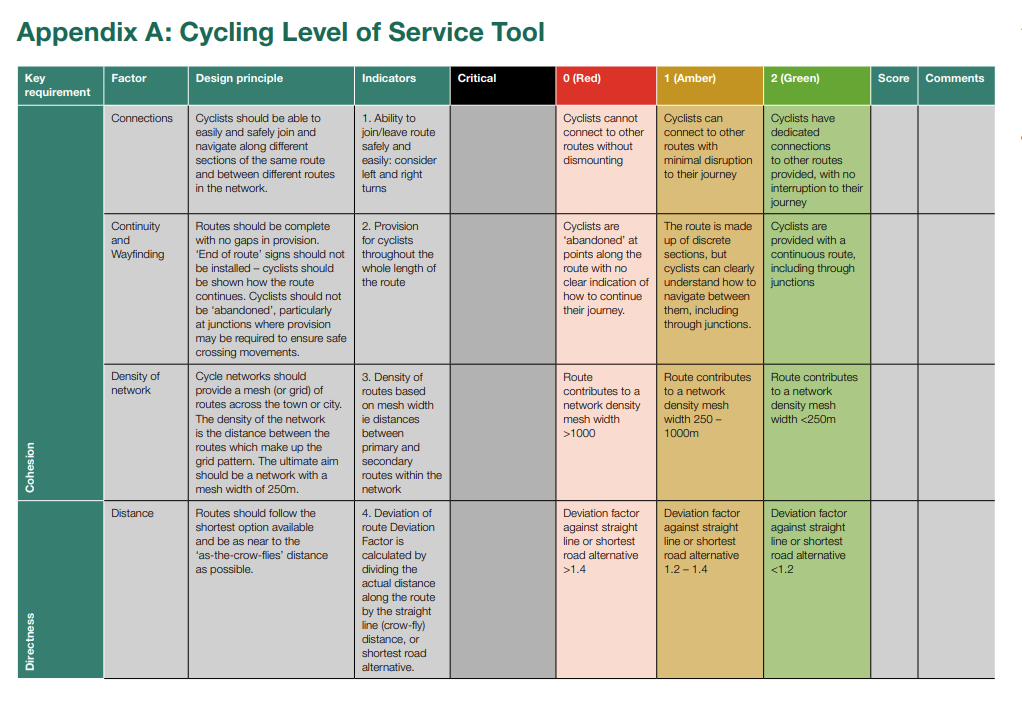
Appendix A of LTN1/20

Red – Where conditions exist that are most likely to give rise to the most common collision types, then the movement should be represented on the plan as a red arrow.

Amber – Where the risk of those collision types has been reduced by design layout or traffic management interventions, then the movement should be coloured amber.

Green – Where the potential for collisions has been removed entirely, then the movement should be coloured green.

‘Green’ should be taken to mean suitable for all potential cyclists; ‘red’ means suitable only for a minority of cyclists (and, even for them, it may be uncomfortable to make). Green movements will exceed the standards that have typically been achieved in the UK to date.

A worked example of how to apply the tool can be found in Appendix B of LTN1/20

Image source: LTN1/20

The CLoS tool includes a simple scoring assessment based on attributes of the five design criteria (Coherent, Direct, Safe, Comfortable and Attractive), which can be used to identify strengths and weaknesses, and therefore what the design needs to address. The tool includes some factors that are considered to be ‘Critical Fails’ – results that represent unsafe conditions for cycling which must be addressed (or an alternative route found). This tool can be found in Appendix A of LTN 1/20.

For the scheme that TMS were involved in the JAT showed that there were some improvements for cyclists along the scheme corridor. A high percentage of green and amber arrows, however due to current highway constraints (corridor widths/third party land) there were several red arrows identified for right turning cyclists deviating from the main line. However, in justification it was considered that the number of cyclists making these right turns would be very low.

The Scheme CLoS achieved a score of 84%, 14% above the desired score and therefore was considered to be acceptable for the DfT.

Road in Bristol with a cycleway.

If you have a scheme of this nature that requires our help on, then please call us on +44 (0)24 7669 0900 or alternatively please email Lorna Styring.

Binley Cycleway

Binley Cycleway, Coventry

Coventry City Council have created a new segregated cycleway along Binley Road, between the Gulson Road and Clifford Bridge Road/ Brinklow Road junctions. A further section exists on Clifford Bridge Road between the Dorchester Way junction and the University Hospital in Walsgrave. Between these sections, there is a “missing link” which will be provided in the future.

TMS Consultancy, whose offices are based in Binley Business Park, are close to the cycleway and therefore provided an ideal opportunity for TMS Engineers to try out the new cycleway. Some highlights of the route are described below:

  1. Two-way cycleway is separated from traffic using kerbed segregation. The surface is high quality asphalt, which is coloured at some junctions and accesses to highlight it to road users.
A person riding a bike on a cycle way.
Copenhagen style crossings

2. Access to private properties have been created using “Copenhagen” style crossings, allowing the route to be continuous without interruption.

3. Cyclists have their own specific traffic signals at controlled junctions and crossings. In most cases, detection equipment gives priority to cyclists so that they turn green as cyclists approach.

Traffic signals at controlled junctions of the cycle way
Parallel Crossing that gives priority to cyclist

4. At side road junctions, Parallel Crossings (similar to zebra crossings) have been provided, giving priority to cyclists and so improving journey times by reducing the need to stop.

5. A cycle maintenance stand and parking is available at one location to allow cyclists to pump up their tyres, tighten bolts, etc, using the multiple tools available at the stand.

Floating stops and raised islands

6. The cycle route is made continuous at bus-stops by creating “Floating” stops on raised islands. The layout features crossing points across the cycle route allowing access for pedestrians.

Overall, our thoughts were that the cycleway provided a pleasant, comfortable, safe and efficient route for cyclists, particularly as it is separated from the busy road.

In our opinion, the cycleway met the core design principles for safe and efficient use by cyclists, which are set out in the Department for Transport Document “LTN 1/20 Cycle Infrastructure Design.” The core principles are that cycle infrastructure should be Coherent, Direct, Safe, Comfortable and Attractive. Once fully completed, the Binley Cycleway will provide an ideal way to cycle between the city centre and the hospital.

If you have a scheme of this nature that requires a Road Safety Audit, then please call us on +44 (0)24 7669 0900 or alternatively please email Lorna Styring.

Back to top